
Chapter 4: Stock Picking
Contents
Stock investing is something that has been made out to be far more complicated than it needs to be. There are far more complicated approaches to stock-picking than those presented in this chapter, but the guidelines presented here will result in 95% of the results of those approaches with only 5% of the time, effort, and confusion. Since the name of this book is Five Minute Investing, I have chosen to build these guidelines in such a way as to minimize your time commitment while helping you avoid the investor mistakes outlined in previous sections.
- 1) Look for positive price momentum
- Most investors search diligently for companies where some good situation is developing – and rightfully so. They do this by asking brokers, looking for stories in the press, etc., but few stop to realize that the stock market itself gives them a list of such companies every day in the form of the new 52-week highs list. Most likely it’s because they have believed some of the misconceptions dealt with in Chapter 1 and wrongly felt that if something appeared on the new-highs list, it’s too late to buy. Actually, nothing could be further from the truth.The simplest, best way to assemble a list of potential high performers is to refer to this new 52-week highs list included in just about every financial newpaper. I highly advocate that investors begin their stock picking expeditions by referring to this list. Remember that companies on the new-highs list do not get there because a certain financial reporter likes them, or because the government thinks they are good for society, or because a brokerage firm will get a hefty commission if the stock appears there. Stock market investors themselves who are knowledgeable about the company in question put them on the list by voting with their own hard-earned dollars, bidding the price up to new highs. Stocks do not appear on it unless there is something in fact really good and tangible happening with the company’s prospects. Furthermore, few good situations develop in one day; they develop over many weeks, months, or years. So, many of the uptrends evidenced in the new highs list will most probably continue on for some time. Not all will, but as long as our strategy allows for weeding out those stocks that do not continue increasing in price we will probably be all right. This part will be dealt with later in the book.
Ask yourself the following two questions:
- How often does a company make a new price high when something good isn’t happening?
- How often does a company where something really good is happening fail to trade close to or at a new high price?
I believe the answer to both of these questions is seldom. All trends eventually come to an end and stocks can go from making new highs to making new lows with breathtaking rapidity. But even in that extreme case, if you utilize the Reverse Scale Strategy introduced in Chapter 7, you may be able to react before major damage is done to your portfolio value. If something very good or bad starts to happen to a company’s earnings trend, it will most likely start to show up in the trend of the stock long before you will read about it in the press – or hear about it from your broker. But the stocks that show positive momentum by appearing on the new-highs list have a excellent chance of continuing their trends. In a nutshell, the new-highs list technique isn’t infallible, but then neither is the stock-picking advice of your broker.
I believe you are almost always better off picking your own investment ideas because you will know why you picked them. Also, you will be more aware of what is happening in the market since you won’t have delegated responsibility for your money to someone else – someone who most likely has hundreds of individual accounts to oversee. It is your money and the more personal attention you can give to it, the better off you will be. Certainly, unless you are very wealthy, you can give more attention to your portfolio than can a broker or advisor. However, it may be best to let your advisor manage the majority of your money, while you try the strategies in this book with your true risk capital.
Finally, if you do not believe that the stocks on the new-highs list tend to outperform others, pick a group of ten stocks from the new highs list and a group from the new-lows list. Track how each group performs over the next few months. Unless you happened to pick a very unusual time period, you will see that the new-highs as a group seriously outpace the new-lows group. If you are into instant gratification, you could also go to the library and pick a random list from a year or two ago and see how they have done since then. If you do, be sure you account for stock splits that may have occurred in the last year, since there may well be some where that has happened – especially among the stocks which appeared on the new-highs list. I highly encourage anyone to perform this simple and unambiguous experiment.
Your performance can be further enhanced by not only choosing stocks making new 52-week highs, but better yet pick stocks that are at all time new highs in price. This will take a little more work for you because you will not find such a list in the newspaper. The best way to distinguish between issues making new 52-week and those making new all time highs is by looking at a long-term chart book. Obviously, any stock making a new all-time high will also be on the new 52-week high list, so begin your search with the 52-week high list.
- 2) Diversify between industry groups
- Because stocks within an industry tend to move more or less in lockstep, make an attempt to diversify your portfolio between at least three industry groups. This will help to reduce some of the risk in your portfolio and having your money spread over several industries will help even out more of the ups and downs in your account value than if you had everything in one industry. Whether you are investing in stocks, fine art, certificates of deposit, bonds, or whatever, the first rule of investing is: Diversify.
- 3) Beware of stodgy stocks
- When selecting stocks, beware of picking those stocks that move very little whether the market is good or bad. These are generally referred to as “defensive” stocks because they are held by those wanting to defend themselves against the possibility of a bear market. These conservative picks tend to underperform the market over the long run, making them a poor substitute for issues with real growth potential. Especially during market downturns, defensive issues hold up well, giving the illusion that there are good things happening to their underlying businesses. In reality, they hold up well mostly because investors flock to them for safety. When the market turns better, these types of companies tend to simply sit still while the rest of the market charges ahead.So, it is best to avoid defensive stocks lest you get left behind when a bull market appears. Issues considered to be defensive include utility companies, gold stocks, food companies, oils, real estate investment trusts, and closed-end mutual funds. Closed-end mutual funds are mutual funds which have a fixed number of shares outstanding and trade just like a stock on an exchange. While they can sometimes post large increases in price, for the most part they sputter along and do not often have the potential for large increases in price.
While there have been times when each of these groups has done very well, for the most part they are a waste of time for those who are willing to take a little more risk in order to make a lot more money. So it is best to exclude defensive stocks, at least from the aggressive portion of your portfolio.
- 4) Weed out takeover situations
- I would generally recommend that you look over recent news items around a company before you make a final decision to buy its stock. The reason I say this is that some of the stocks on the new-highs list are stocks of companies which are involved in real or rumored merger or buyout situations. They are generally a small minority of the stocks on the new-highs list, but be aware that this possibility exists. Takeovers and buyouts are unnatural, all-at-once events which are highly speculative and thus do not lend themselves to prudent investing. Once a firm is known to be a potential takeover target the price is dominated not by the company’s market position or products, but rather by the development of the buyout offer. Also, most of the potential for further price advances is gone once the initial “pop” from the buyout has occurred.For purposes of this book, try to avoid buying stocks which have become known to be the target of a buyout. Buyouts, when they occur, are big news and are generally well-known. The easiest way I have found to spot companies where a takeover has occurred is by looking at the price chart. Takeovers are almost always evidenced by a one-day increase in the price of the target company’s stock of between 20% and 100%. If you see that type of pattern, dig deeper. There is an excellent chance that this company is in a buyout situation and should therefore be avoided.
- 5) Check out the Chart
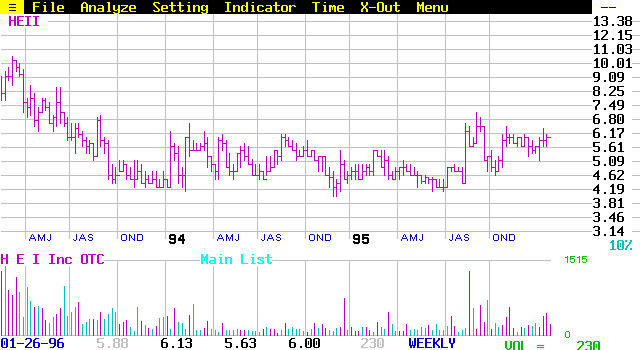
- Before you buy a stock, take a look at its price chart for the past year or two. This will give you a snapshot of the stock’s personality from a volatility standpoint. I like to avoid stocks which have high week-to-week volatility and instead prefer ones which have a tendency for a cleaner trend. If a stock has a very volatile price pattern, then it generally means the company has no clear advantage in the marketplace for its product, services, etc., versus the competition. Since there are many companies out there which do have a clear, sustainable advantage in their particular market, I generally opt to purchase these instead. As an extreme example, following is a chart of a stock which has shown a very volatile price pattern in the past year:
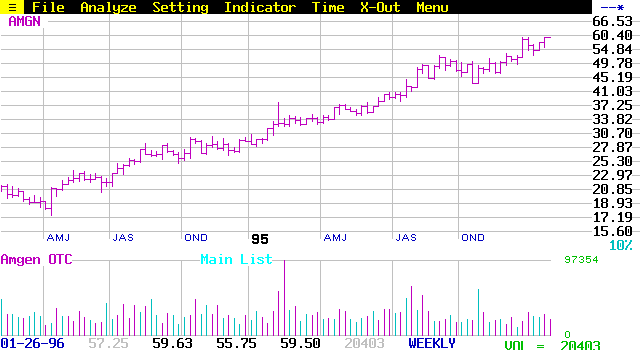
As an example of a stock which shows an excellent trend pattern and low volatility, study this chart of Amgen, Inc. As you can see, the stock is making a new all-time high combined and is moving more steadily upward than many other stocks. I would tend to favor a stock with this type of price chart.
In addition to volatility, the chart can also give you a clue to other important facts about the stock, such as if it’s in the midst of a takeover situation (characterized by a large one-day move and a relatively stable price pattern thereafter), or whether it’s a new issue. New issues sometimes appear on the 52-week highs list not because they are particularly strong stocks, but simply because they do not have much trading history behind them. It is best to know about these things and I can think of no faster way of finding out than by looking at the stock’s chart.
There are several ways to obtain a chart of a company’s recent price history. By far the best and cheapest way these days is by computer, but there are many published chart services as well. Mansfield Charts and Daily Graphs are good choices. Standard and Poor’s also publishes a compact book of stock charts which give two years’ price history on many stocks.
Keep in mind that no matter how you get your chart information, you only need it when intitially selecting a stock for purchase with Five Minute Investing. As you will see later in the book, you do not need to lug a computer or chart book around with you in order to manage your portfolio. Charts are only useful for getting a quick feel for the stock’s trend, volatility, and as a tipoff for weeding out takeovers and new issues. In Five Minute Investing, they are not necessary for day-to-day management of your portfolio.
- 6) Other Criteria
- Other than what’s already been mentioned, are there other criteria which are simple but can help you narrow your stock picks down to a more succinct list? Yes, and I will try to give a brief overview of them here. You can then choose how many of these criteria you would like to use. No matter how few you choose to use, as long as you apply the first four sections of this chapter you will not go too far wrong. These items should be considered “finesse points” that can be used to narrow your choices down to a select few.
- Earnings Growth.
One way to further narrow your list of potential stocks is to focus on those that are reporting high rates of earnings growth. Do not think that because a company is presently generating rapid earnings growth that it cannot continue to do so well into the future. It often takes years or even decades for competition to nullify such a company’s competitive edge in the products or services it provides, and it is this competitive edge that allows the rapid growth in sales and earnings. So, pay close attention to the earnings trend of your potential stock selections. Where can you get this information? It can be gotten from any number of publications including Standard and Poor’s and also the Value Line Investment Survey. So far, though, the easiest place to find summary information on earnings growth is Investor’s Business Daily. IBD has earnings per share rankings for every stock in the market, every day. For this reason, it is superior to the other sources of information because all the information can be found in one place, and in a similar format so that each company’s earnings growth number can be directly compared to every other company. IBD categorizes earnings growth on a percentile basis, called the Earnings Per Share ranking. This number ranges between 1 and 99, with 99 being the most positive. All else being equal, try to pick issues which have the highest earnings growth, because these are the companies which have a demonstrated edge in their particular market. - Market Capitalization.
Market capitalization is another thing you will want to pay attention to. Market capitalization is simply the total market value of all the company’s outstanding shares, or total shares multiplied by the price per share of the company’s stock. I generally like to avoid the very biggest capitalization stocks, say those with capitalizations over $5 billion (in 1995 dollars) or so. This number will change over time, since the definition of a “big” company is constantly increasing.Why take market capitalization into account when picking stocks? The larger the base of earnings a company is working from, the less likely they are to be able to grow earnings at a sustainable clip of 30% or more – and the less likely we are to be rewarded with a windfall profit. So, try to stick with the smaller-company stocks appearing on the new-highs list. - Buy the Price Performers.
Try to choose stocks that have performed well versus other stocks in the market, from a price standpoint. Simply put, choose the stocks that have run up most in value. This approach goes directly against human nature, but by adding this to your list of criteria you will greatly increase your chances of finding a phenomenal winner. You can determine how well a stock is doing by looking at it’s current price versus its 52-week low (not high). The higher it is in percentage terms versus its low point, the better. Or, an easier way is to use Investor’s Business Daily because it provides Relative Strength rankings on every stock, every day. If you are using Investor’s Business Daily, also try to choose stocks with a relative strength ranking that is high. Like the EPS ranking mentioned earlier, this runs from 1 to 99, with 99 being the most favorable and meaning that the stock is moving upward in price better than 99% of the stocks in the market. I like to focus on stocks exhibiting a relative strength ranking of 90 or better. If you do not have a subscription to IBD, make sure you at least pick up a newstand issue whenever you are picking new stocks to invest in, as by now you can see how much time and effort it can save you in gathering information. I consider this publication to be well worth the price of an annual subscription. - Share Price.
Finally, try to limit your purchases to stocks sporting a share price at or above $15/share. By so doing you will enhance your chances of investing in stocks with good trending potential. Low-price stocks tend to have very choppy trading patterns and are much more subject to false trend reversals. I actually prefer to invest in stocks priced in the $30 to $50 price range, as I find they are often well-established enough to have a high success rate, but if they are smaller capitalization issues they also are small enough to have nice growth potential.
- Earnings Growth.
Short-term timing
Many investors let short-term timing considerations overwhelm their choice of which stocks to buy. I believe this is an error, and also greatly complicates their stock-picking criteria. People become so confused by what is happening with short-term oscillators, moving averages, chart formations, and other mumbo-jumbo that these things begin to dominate all other considerations. In this book I want to totally de-emphasize short-term timing and focus on the big picture: Long-term results.
The simple reason for my philosophy is, I would rather buy a stock that is overextended and may have a relatively small short-term pullback in price but on its way to a 1,000% gain than one that is not at all extended but on its way to only a 50% gain. In fact, on weekends I often look at the largest percentage price gainers for the week and I strongly consider those stocks for purchase. I am not afraid to buy a stock just because it is moving decisively upward. I believe that if you use the Reverse Scale Strategy as developed later in this book, you will accumulate your positions gradually enough that you will not need to worry about whether a stock is overextended, underextended, or other short-term timing concepts. Therefore, you can keep your stock-picking techniques as simple as what is presented in this chapter.
Fundamental Analysis
You may have noticed that there is nothing in this chapter regarding how to perform fundamental analysis of industries, companies within that industry, financial analysis of earnings statements and balance sheets, etc. Perhaps you expected any book on stock picking to include these topics, but Five Minute Investing does not. The simple reason for this is that if the market is saying that a certain company’s earnings are expected to grow (evidenced by an accelerating upward stock trend), why should we find reason to dispute what the market is saying? As long as we have a loss-cutting mechanism in place, we do not need to use fundamental analysis to validate what the market already has told us about the future earnings of the company. The opinion of the aggregate marketplace has far more credibility in my eyes than does the opinion of any fundamental analyst, no matter how good. So I will always go with the opinion of the market, as opposed to anyone else’s opinion, including my own. To me, anyone who tells me that a stock which is moving up shouldn’t be moving up, has by definition missed something in his analysis.
To make my point on the futility of fundamental analysis for the average investor, think of how you would determine if the grass in your lawn was growing quickly. Wouldn’t you just measure the grass today, wait a few days, then measure it again and subtract? If you did this and discovered that the grass was growing quickly, would you then go out and conduct a survey of the temperature, rainfall and hours of sunlight per day to validate that the conditions for growing grass are indeed good? Of course not! You would rightly conclude that the conditions for grass growth are good based soley on the fact that the grass is growing. Even if you did cook up some formula to predict grass growth based on environmental conditions, would you trust your formula more than your direct measurement of the grass’s actual growth? If your formula said that grass shouldn’t be growing and yet it was growing, would you stop mowing your lawn? Again, to do so would be preposterous. You would have to conclude that something is wrong with your formula.
Unfortunately, common sense of this sort does not get applied in the stock market by many people. Even though we can directly measure through a stock’s price trend what the company’s growth prospects must be, there is always someone there to try to make us lose sight of that simple fact by pointing to his “analysis.” You can be sure that for every fantasticly bullish trend, there is some analyst somewhere saying why it shouldn’t be happening all along the way.The best you can do is to not listen to such opinions, and, again, go back to the market as your one source of advice.
A final word: Buy Quality
Whether you are investing in stocks, art, coins, or real estate, it is my opinion that it is always best to buy the highest quality you can possibly afford. Any review of the return on rare coins or masterpieces of fine art will quickly reveal that the best returns on investment have been enjoyed by those who bought the rarest and highest-priced items. The same principle is true in stock investing. Do not be afraid to pay a high price relative to earnings, book value, or sales. In fact, I would ignore such items. I recommend that you buy the stocks which are moving up persistently in price, and don’t concern yourself that these stocks tend to cost a little bit more than some more boring issues. History shows that the premium paid for high-quality items of any kind is generally worth the extra money.
When picking stocks for investment, apply these criteria:
- Restrict your stock-picking to stocks making new 52-week highs.
- Diversify between at least three different industry groups.
- Weed out defensive stocks and those involved in buyout situations.
- Don’t be afraid to pay up for quality.
Five Minute Investing Course
Introduction
Chapter 1: Replacing Our Stock Market Myths
Chapter 2: Things to Avoid
Chapter 3: Know Yourself
Chapter 4: Stock Picking
Chapter 5: How to Evaluate a Trading Strategy
Chapter 6: The World’s Worst Trading Strategy
Chapter 7: The Reverse Scale Strategy
Chapter 8: Margin Power
Chapter 9: Implementing the Reverse Scale Strategy
Chapter 10: Getting Started